
AI engineer roles jumped from 2.7% to 8.4% of tech job postings while entry-level hiring for ages 22-26 dropped roughly 20%.
Call-center roles declined 15% in the same period.
These numbers are happening simultaneously, inside the same companies, and nobody is connecting them.
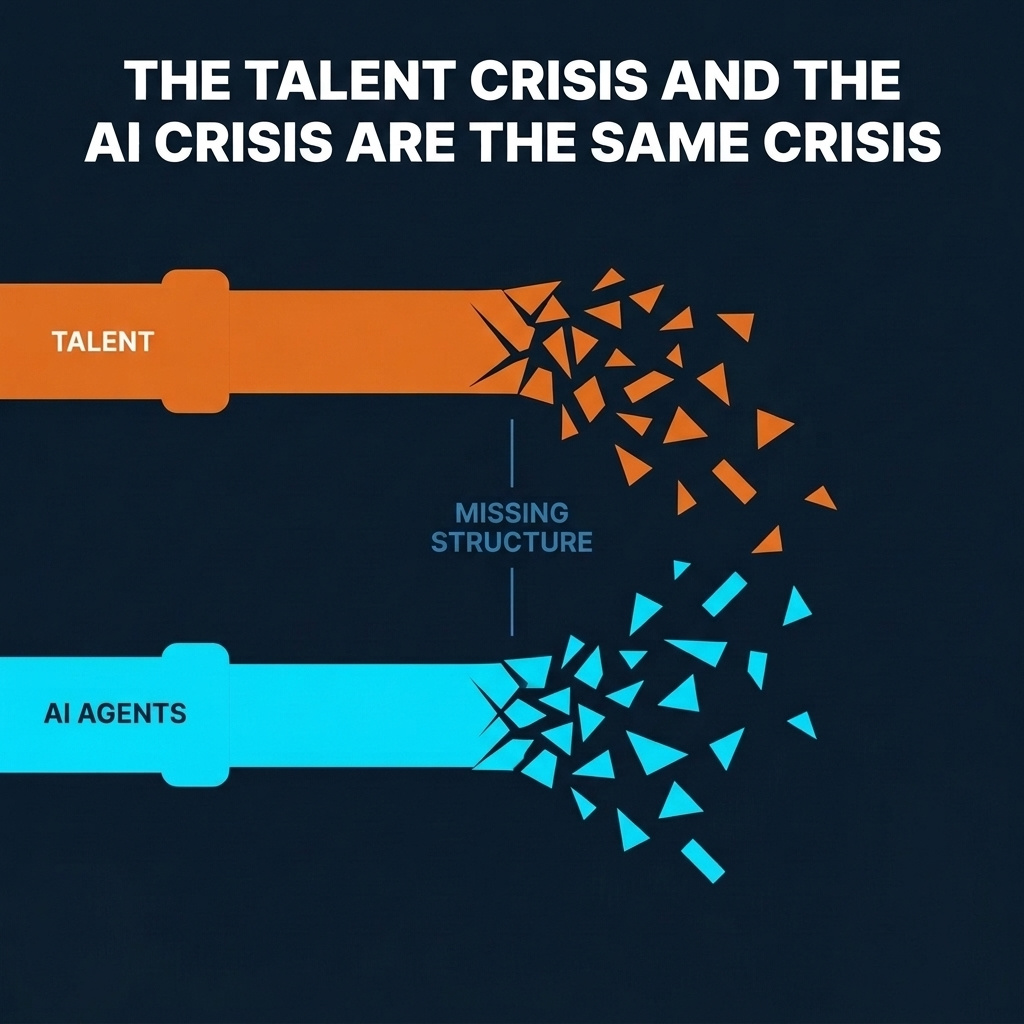
The pattern reveals something most operators miss: the talent pipeline crisis and the AI deployment crisis have the same root cause.
Both fail because of missing structure.
The Numbers Tell a Story Nobody Wants to Hear
LinkedIn ranked AI Engineer as the fastest-growing job title in the United States, with postings rising 143% year-over-year in 2025.
Meanwhile, new grads now account for just 7% of hires at Big Tech, down from 15% before the pandemic.
The average age of technical hires increased by three years since 2021. Companies stopped investing in junior talent.
Over the last three years, the number of fresh graduates hired by big tech companies globally has declined by more than 50%.
The junior analyst not hired today is a future CFO who cannot be promoted tomorrow.
This is not just an employment problem. It is a skill formation crisis.
The AI Wage Premium Reveals the Gap
Roles requiring AI skills carry a 56% wage premium over comparable non-AI positions, up from 25% just one year earlier.
Nearly 90% of companies created new AI-related positions, although a majority still worry about workforce shortages.
The result: 37% of managers say they would rather use AI than hire a Gen Z employee.
Fresh graduates are asked to increase output by 70% because they use AI — without corresponding structural support or role clarity.
The skill polarization is extreme and accelerating.
Multi-Agent AI Systems Fail the Same Way
40% of multi-agent pilots fail within six months of production deployment.
The cost problem is dramatic. A three-agent workflow costing $5-50 in demos can generate $18,000-90,000 monthly bills at scale due to token multiplication.
You end up with a system that costs $5 per run to do a task that saves $0.50 of human time.
Most agent failures are not model capability failures. They are orchestration and context-transfer issues at handoff points between agents.
Coordination among numerous agents creates communication overhead, message congestion, and performance bottlenecks unless workflows are carefully managed.
This echoes the exact problem in talent management: lack of defined roles and clear ownership creates compounding chaos.
The Duplication Problem Compounds at Scale
Without clear task definitions, agents become doppelgangers of each other.
They double up on work. They double token costs. They double output volume. They double the amount of verification required.
Coordinating multiple agents increases token usage and processing time, amplifying costs significantly.
Fewer than 10% of organizations successfully scale beyond single-agent deployments. The rest hit walls around coordination, monitoring, or spiraling costs.
Gartner predicts over 40% of agentic AI projects will be canceled by the end of 2027 due to escalating costs, unclear business value, or inadequate risk controls.
The pattern is identical to what happens when you hire without defining roles.
Call Centers and the Jevons Paradox
AI will slash the number of customer service jobs in half by 2030, according to Forrester.
But here is the paradox: from 2016 through 2025, call center employment in the Philippines has risen each year, nearly doubling to 2 million over the 10-year span.
As AI makes call center work cheaper and faster, companies are buying more of it, not less.
Lower cost per interaction does not mean fewer interactions. It means more volume with the same structural problems underneath.
The efficiency gain gets absorbed by increased demand, and the coordination problems remain unsolved.
The Root Cause Is Structural
Companies are optimizing for the wrong variables.
They chase cost reduction without addressing the underlying architecture. They add AI capabilities without defining how those capabilities integrate with existing workflows.
They hire senior talent without building the pipeline that produces senior talent.
Systems thinking creates massive opportunity for people who see pipelines rather than single-channel tactics.
The ones chasing individual solutions without understanding the system will wonder why their costs keep rising and their output keeps declining.
Data flows in, gets transformed, gets routed to the right place, and creates an outcome. That is how marketing works. That is how AI deployment works.
Without structure, you get chaos at every handoff point.
What the Pipeline Actually Looks Like in Three Years
If this trajectory holds, here is what happens:
The senior talent shortage becomes acute. Companies that stopped hiring junior roles in 2023 will have no mid-level talent in 2026 and no senior talent in 2029.
AI deployment costs spiral. Organizations that deployed multi-agent systems without governance will face bills that exceed the value of the work being automated.
The skill gap widens. The 56% wage premium for AI skills will increase as demand outpaces supply, making it prohibitively expensive to hire the people who can actually build and maintain these systems.
Coordination overhead becomes the primary cost. The expense will not be in the technology itself but in managing interactions between agents, teams, and systems never designed to work together.
The companies that survive this transition will be the ones that built structure before they needed it.
What B2B Operators Need to Build Now
Define roles with precision. Every person on your team should have a clear mandate. Every AI agent in your system should have a defined task boundary.
Build redundancy without duplication. Systems should run without requiring heroic effort from any single person. Install failsafes. Create space for people to be human again.
Map the handoff points. The failures happen at transitions. Identify where context gets lost, where ownership becomes unclear, where verification requirements multiply.
Measure pipeline value, not vanity metrics. Track how many junior hires become mid-level contributors. Track how many AI workflows actually reduce human workload versus shift it.
Invest in the 80/20 of the 80/20. Isolate the core mechanics that actually move outcomes. Eliminate everything else.
Automation exists to restore human capital, not replace it. The goal is giving people their lives back while the business continues to perform.
The talent pipeline problem and the agent architecture problem are the same problem. Without structure, without defined roles, without clear ownership, you get compounding chaos at scale.
Build the structure now. Before the pipeline runs dry.