
TL;DR: AI generates infrastructure code faster than engineers can understand it. That gap between generation speed and human comprehension is where invisible failures accumulate. The fix is not better AI. It is better architecture.
-
42.7% of syntactically correct infrastructure-as-code templates fail during deployment.
-
Organizations using AI-generated code saw a 322% increase in privilege-escalation paths and a 153% increase in architectural flaws.
-
Multi-agent LLM systems degrade silently through topical state drift, not just hallucination.
-
Daisy-chaining specialized models, each with one constrained task, reduces failure rates and improves accuracy by 30% or more.
-
The bottleneck in AI-assisted development has moved from creation to comprehension. Speed is no longer the constraint.
When Speed Outpaces Understanding
AI generates infrastructure-as-code faster than engineers can read it. Terraform configurations. Cloud setups. HCL templates. The output looks clean. It passes syntax checks. It gets deployed.
Then it breaks. Not immediately. Not obviously. It breaks in ways that compound invisibly until the cascade hits production.
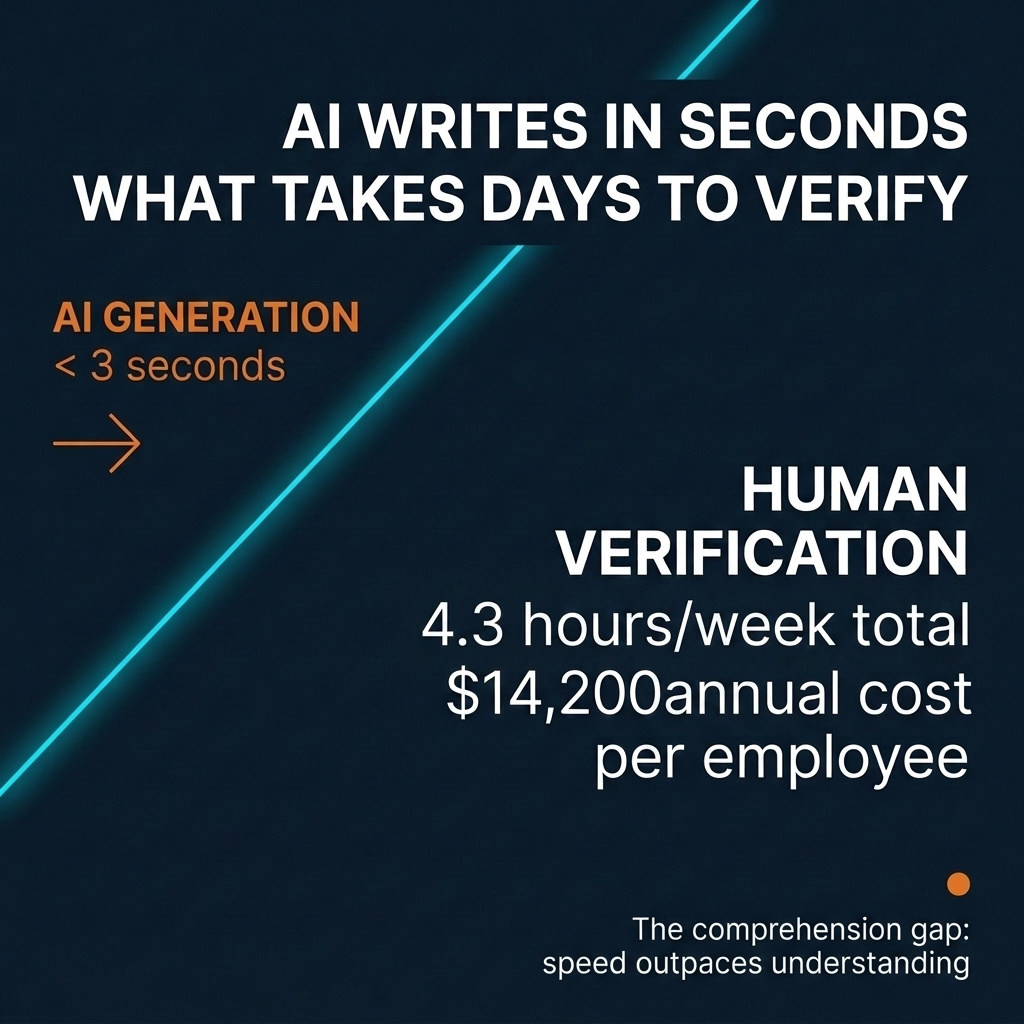
The problem is not the hallucination rate. The problem is the comprehension gap: the distance between how fast AI generates output and how fast humans can actually verify it.
42.7% of syntactically correct infrastructure-as-code templates fail during deployment. These templates pass basic validation. They look right. But they contain architectural flaws that only surface under deployment stress. The AI wrote code faster than the team could verify it works in production. That gap creates invisible risk.
Organizations using AI-generated code experienced a 322% increase in privilege-escalation paths and a 153% increase in architectural flaws. Technical debt costs $2.41 trillion annually in the US. If even 10% stems from comprehension failures in AI-generated code, that is $240 billion in annual costs from systems built faster than teams can understand them.
The issue is not whether AI makes errors. The issue is whether humans can verify complex outputs fast enough.
Key Point: The comprehension gap is a structural risk, not a model quality problem. It grows as AI generation speed increases.
Why Infrastructure Risk Is Different
A bad application deploy can usually be rolled back. A bad infrastructure change can destroy a production database.
This is what makes the comprehension gap dangerous in infrastructure work. The stakes are asymmetric. Learning by breaking things is not an option when those things are foundational systems.
Speed without understanding creates catastrophic failure modes. Knowledge workers now spend an average of 4.3 hours per week verifying AI outputs. Each enterprise employee costs companies roughly $14,200 per year in hallucination-related mitigation efforts. The verification burden grows faster than the productivity gains.
Key Point: Infrastructure errors are not reversible the way application bugs are. The asymmetry of consequences makes the comprehension gap a safety issue, not an efficiency issue.
State Drift: The Invisible Degradation
The same problem exists inside multi-agent AI systems. After about five turns, most AIs start to drift from context. For larger models, the threshold sits around 200,000 to 300,000 tokens. When those levels are hit without clearing or backing up state, the system drifts and does unexpected things.
This is called topical state drift. The weights stay the same. The code stays the same. But the behavior changes.
Agent drift occurs when decision-making patterns progressively deviate from design specifications without explicit parameter changes or system failures. Traditional DevOps monitoring cannot detect this. The system looks healthy while it silently degrades.
Context windows fill with irrelevant information from early interactions. The signal-to-noise ratio of relevant context degrades. Decision quality drops. Multi-agent setups require agents to pass messages containing instructions, constraints, reasoning history, shared knowledge, and goals. But LLMs have limited context windows. As irrelevant tokens accumulate, instructions drift. Goals mutate. Constraints weaken. This is called context collapse. It is one of the biggest reasons multi-agent LLM systems fail on longer tasks.
The Lost-in-the-Middle Effect
Transformer attention mechanisms perform worse on information in the middle of the context. Expanding the does not fix it. A model can exhibit severe context rot on middle-position content even when the window is only half full. Simply increasing token limits does not solve the state drift problem.
Enterprise AI queries consume 50,000 to 100,000 tokens before the model begins reasoning. Performance dropped 39% on average from single-turn to multi-turn interaction in testing across 15 LLMs and 200,000+ simulated conversations. This quantifies how quickly complex systems degrade as context accumulates.
Key Point: State drift is silent. It does not trigger alerts. It does not throw errors. The system appears functional while its decision quality quietly collapses.
The Productivity Paradox
As AI adoption increased, delivery throughput declined by 1.5% and stability declined by 7.2%. Code is being written faster than ever. It is not reaching production any quicker.
This DORA research finding captures the core paradox. AI generates output faster than organizations can validate, integrate, and deploy it safely. The bottleneck moved from creation to comprehension.
Speed without understanding is not a productivity gain. It is a delayed liability.
Key Point: Faster generation without faster comprehension creates a debt problem, not a delivery advantage.
The Architectural Answer: Specialized Agents
The solution is not fighting the constraint. The solution is working with it.
Instead of asking one LLM to handle everything, multiple LLMs are chained together in a row. One handles titles. Another handles outlines. A third handles paragraphs. A fourth handles research. The fifth ties it all together. Each one does an autonomous, independent job. When they finish, there is a full report.
Short, feedable, consistent tasks. Specialized models that each stay in their lane. No single model is ever asked to hold too much at once.
Domain-specific training delivers accuracy improvements of 30% or more compared to general-purpose models. CrowdStrike increased alert triage accuracy from 80% to 98.5%, reducing manual effort 10x. This demonstrates the architectural principle of constrained, specialized agents versus single LLMs handling everything.
Modular Design Prevents Fragility
Multi-agent patterns provide a modular design that improves scalability, reliability, and maintainability compared to a single agent with a monolithic prompt. The core principle is to decompose a large objective into smaller sub-tasks and assign each sub-task to a dedicated agent with a specific skill.
Each agent operates autonomously and can be added, removed, or updated without retraining the orchestrator. This architectural principle prevents the fragility of tightly coupled systems. When one component fails, it does not cascade through the entire system.
Key Point: Modular agent architecture does not just improve performance. It contains failure. That is the structural advantage.
Redundancy Through Diversity
Multi-model verification architectures reduced hallucination rates by 61%, cutting enterprise errors from 8.3% to 3.2%. This works because different models trained on different data, with different architectures and training procedures, make different errors. A factual claim one model confidently fabricates may be one another correctly identifies as unverifiable.
This validates the principle of redundancy through diversity. Outputs are not relying on a single point of truth. They are cross-checked across multiple specialized systems.
Key Point: Diverse model architectures create natural error-checking. One model’s blind spot is another model’s strength.
Building Systems That Work While You Sleep
The philosophy is straightforward. Build the systems first. Then use skilled humans to manage, extend, and optimize those systems. Not the other way around.
Automation exists to restore capacity. The goal is not efficiency for its own sake. The goal is giving people their time back while the business continues to perform. One person with the right systems outperforms a team of ten doing manual work. That is where the leverage exists.
Repeatable, automated systems run independently. Not one-off hacks. Not clever tricks. Systems that compound over time.
Key Point: The right architecture does not just scale output. It reduces the human cost of maintaining that output over time.
What This Means in Practice
The comprehension gap is not going away. AI will keep generating output faster than humans can verify it. The organizations that win will be the ones that architect around this constraint instead of pretending it does not exist.
Break complex tasks into constrained, specialized sub-tasks. Chain specialized models together. Build verification into the architecture. Create redundancy through diversity. Design systems where no single component becomes a point of failure.
This is infrastructure work. Architecture work. The kind that does not fit in a package but defines how a company operates for years.
Stop asking one model to do everything. Start building systems that work with the constraint instead of fighting it.
Frequently Asked Questions
What is the comprehension gap in AI-generated code?
The comprehension gap is the distance between how fast AI generates infrastructure code and how fast human engineers can verify it. When generation speed outpaces understanding, errors accumulate invisibly until they cause system failures.
Why do syntactically correct infrastructure templates still fail?
Syntax checks confirm structure, not logic. 42.7% of syntactically correct infrastructure-as-code templates fail during deployment because they contain architectural flaws that only surface under real deployment conditions.
What is topical state drift in multi-agent AI systems?
Topical state drift is when a model’s behavior progressively deviates from its design specifications as context accumulates, without any explicit changes to parameters or code. The system looks functional but its decision-making degrades.
What is context collapse?
Context collapse occurs when irrelevant tokens fill a model’s context window, degrading the signal-to-noise ratio of useful information. Instructions drift. Goals mutate. Constraints weaken. It is one of the primary failure modes in multi-agent LLM systems.
What is the lost-in-the-middle effect?
Transformer attention mechanisms perform worse on information positioned in the middle of the context window. Expanding the context window does not resolve this. It is an architectural characteristic of current LLM designs.
How does daisy-chaining LLMs reduce failure rates?
By assigning each LLM a single, constrained task, no model is ever asked to hold too much context at once. This reduces state drift, keeps decision quality high, and contains failures to isolated components rather than allowing them to cascade.
Why does multi-model verification reduce hallucination rates?
Different models trained on different data make different errors. When outputs are cross-checked across multiple specialized systems, one model’s fabrication is likely to be flagged by another. This architecture reduced hallucination rates by 61% in enterprise deployments.
Does increasing context window size fix state drift?
No. A larger context window does not resolve the lost-in-the-middle effect or topical state drift. Models can exhibit severe context rot even when the window is only half full. The architectural solution is task decomposition, not larger windows.
Key Takeaways
-
The comprehension gap, not hallucination rate, is the primary driver of invisible AI infrastructure failures.
-
42.7% of syntactically correct infrastructure-as-code templates fail during deployment due to architectural flaws.
-
AI adoption correlated with a 1.5% decline in delivery throughput and a 7.2% decline in stability, per DORA research.
-
Topical state drift causes multi-agent systems to degrade silently, without triggering standard monitoring alerts.
-
Daisy-chaining specialized LLMs, each with one constrained task, reduces state drift and improves accuracy by 30% or more.
-
Multi-model verification architectures reduced enterprise hallucination rates by 61%.
-
The architectural principle is simple: decompose complexity, specialize agents, build in redundancy, and design for failure containment.