
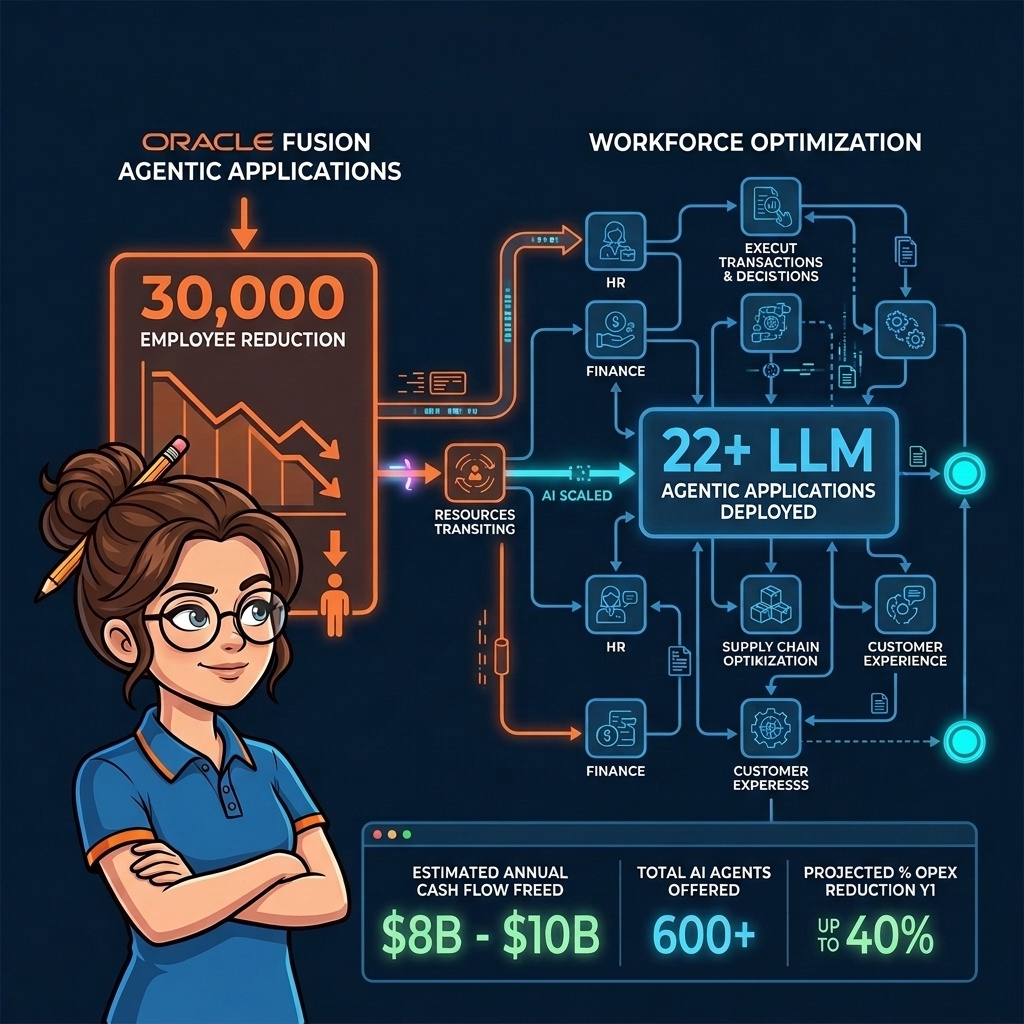
TL;DR: Oracle is cutting 30,000 employees and deploying 22 LLM-powered agentic applications inside Oracle Fusion simultaneously. That is not a coincidence. It is a preview of the competitive environment B2B operators will face in the next 18 months.
-
Oracle cut 18% of its global workforce, its largest workforce reduction in company history.
-
Oracle now offers 600-plus AI agents inside Fusion Cloud, covering HR, finance, supply chain, and customer experience.
-
TD Cowen estimates the layoffs free up $8 to $10 billion in annual cash flow, redirected toward $50 billion in AI infrastructure spending.
-
Gartner predicts 40% of enterprise applications will include task-specific AI agents by end of 2026, up from less than 5% today.
-
40% of agentic AI projects are predicted to be canceled by end of 2027, primarily due to poor infrastructure and unclear business value.
The Pattern Worth Recognizing
The companies cutting headcount and the companies deploying agents are often the same company. Oracle is not unique. They are visible. Oracle expects to complete layoffs of nearly 30,000 employees by June 15. That is 18% of their global workforce, the largest workforce reduction in the company’s history.
At the same time, Oracle now offers more than 600 AI agents inside its Fusion Cloud Applications Suite. Twenty-two new Fusion Agentic Applications were deployed, built from teams of AI agents integrated across HR, finance, supply chain, and customer experience. The timing is not accidental.
TD Cowen estimates the layoffs will free up $8 to $10 billion in annual cash flow. Oracle committed approximately $50 billion in capital spending for fiscal year 2026 alone toward AI infrastructure. Oracle’s SaaS division absorbed some of the heaviest cuts. The direction is clear: less traditional software, more AI.
Key Point: Oracle’s simultaneous layoffs and AI deployment are a reallocation strategy, not a contradiction. The freed capital is being redirected toward agentic infrastructure.
What Makes This Different From Past Technology Shifts
Building automation systems since 2006 means watching many technology waves roll in. Each one promised transformation. Most delivered incremental improvement. This one is different, and the reason is specific.
Being native to the transactional system enables Fusion Agentic Applications to execute in real time, at enterprise scale, with full governance. This is not a copilot. Not an AI assistant. Not an add-on. These agents execute transactions, make decisions, and operate inside the core systems that run the business.
The shift from AI that talks to AI that does is happening faster than most operators recognize. Gartner predicts 40% of enterprise applications will be integrated with task-specific AI agents by the end of 2026, up from less than 5% today. That acceleration means 2026 is the year AI agents move from experimentation to production. 60% of large enterprises are already in production-level deployments. The early-mover window is closing.
Key Point: The defining difference in this technology shift is execution at enterprise scale with full governance. AI that talks has been replaced by AI that does.
The Human Capital Question Nobody Wants to Answer
37% of business leaders report they expect to replace human workers with AI by the close of 2026 as companies move from pilots to full-scale automation. 40% of employers anticipate reducing workforce where AI agents can automate tasks. In the tech sector alone, more than 40,000 jobs were cut in March, with many firms explicitly linking the reductions to AI and automation.
Two decades of building systems that remove bottlenecks from companies outgrowing their infrastructure informed a core conviction: automation exists to restore the human element, to give people their capacity back while the business continues to perform. The Oracle situation forces a harder question.
When enterprise AI moves from productivity tool to workforce replacement, the calculus changes. The companies making these moves are not eliminating inefficiency. They are re-engineering their operating models around a fundamentally different assumption about what work requires human judgment. This is not about eliminating repetitive tasks. This is about redefining which functions justify human capital allocation.
Key Point: The data indicates enterprise AI is no longer augmenting human work. It is replacing the need for certain categories of human decision-making entirely.
The 18-Month Window for B2B Operators
If a B2B company is scaling between $2M and $200M, the Oracle rollout is not a distant enterprise problem. It is a preview of the competitive environment ahead in the next 18 months. The organizations building the right foundations today are the ones that will own a structural cost advantage over the next decade.
Three questions separate the companies preparing for this shift from the ones that will be left behind.
Which High-Volume Processes Are Candidates for Agentic Automation?
The answer is not about what seems appealing to automate. The answer is about what competitors will automate. If Oracle deployed 600 agents across HR, finance, supply chain, and customer experience, similar evaluations are happening at competitor organizations right now. The companies that move first build cost structures that become very difficult to match.
Do You Have the Data Quality and Governance Infrastructure That Agentic AI Requires?
The agents themselves work. Shipping them at enterprise scale, under enterprise governance, across enterprise infrastructure is where the gap exists. This is the central problem of enterprise AI in 2026. Gartner predicts more than 40% of agentic AI projects will be canceled by end of 2027, primarily due to escalating costs, unclear business value, and inadequate risk controls. Only 21% of organizations have a mature governance model. The difference between the 5% that ship and the 95% that do not comes down to infrastructure, governance, and strategic clarity.
Are You Building a Coherent Agentic Architecture or Accumulating Disconnected Tools?
Most companies are not building systems. They are accumulating tools. The distinction matters. Oracle did not deploy 600 disconnected agents. They built an integrated architecture where agents coordinate across functions. The value is not in individual agents. The value is in the orchestration layer that allows agents to work together. Buying point solutions without an integration strategy builds technical debt that slows everything down when speed matters most.
Key Point: Three variables determine whether a B2B operator is building a competitive advantage or falling behind: process prioritization, governance readiness, and architectural coherence.
What the ROI Actually Looks Like
Enterprise AI agent adoption is growing at roughly 41% annually, with leading organizations using these platforms to reduce operational overhead by up to 40% in year one. That is not incremental efficiency. That is a step change in how work gets done.
Oracle provides a specific measurement framework. Their Agent ROI dashboard measures time saved, cost savings, and productivity gains per agent across workflows, teams, and business functions. The measurement framework matters as much as the technology. Without measuring impact, investment cannot be justified. Without justified investment, the budget to compete does not materialize.
Key Point: ROI measurement is not optional. Organizations that cannot quantify agent impact will lose budget, then lose ground.
The Failure Mode to Avoid
Not everyone succeeds in this transition. Nearly two decades of building automation systems produced a consistent pattern. The technology is rarely the constraint. The constraint is always inadequate infrastructure, unclear business value, and lack of governance.
The companies that succeed will treat agentic AI as infrastructure work. Not a feature. Not an experiment. A fundamental re-engineering of how the business operates. That requires thinking in systems rather than tactics. It requires building the integration layer before deploying agents. It requires governance frameworks that allow agents to operate safely at scale.
Most companies will skip these steps. They will deploy agents without infrastructure. They will measure activity instead of outcomes. They will accumulate technical debt faster than they create value. The 40% failure rate Gartner predicts is not a technology problem. It is a strategic execution problem.
Key Point: Agentic AI projects fail at the infrastructure layer, not the technology layer. Governance and integration strategy must come before deployment.
What to Do Right Now
The Oracle announcement is not a signal to panic. It is a signal to prepare.
Start by mapping the highest-volume operational processes. Identify where human judgment is required and where execution is repeatable. Repeatable execution is where agentic AI creates immediate value. Then audit data quality and governance infrastructure. If the data is not clean, agents will not work. If governance is not mature, agents will create risk faster than value.
Build an integration strategy before buying more tools. The value is not in individual agents. The value is in orchestration. Isolated experiments without connection to core systems do not become integrated capabilities. Measure outcomes instead of activity. Time saved matters. Cost savings matter. Productivity gains matter. Everything else is noise.
The companies that do this work now will own their space for the next decade. The ones that wait will spend the next 18 months wondering why competitors are operating at cost structures they cannot match.
Oracle showed what enterprise AI looks like when it moves from experiment to execution. The only variable left is whether the right infrastructure is being built to compete in that environment.
Build the systems now.
Frequently Asked Questions
Why is Oracle laying off 30,000 employees while deploying more AI?
The layoffs and AI deployment are part of the same reallocation strategy. Oracle is freeing up $8 to $10 billion in annual cash flow by reducing headcount and redirecting that capital toward $50 billion in AI infrastructure spending. The SaaS division absorbed the heaviest cuts as Oracle shifts from traditional software toward agentic AI.
What are Oracle Fusion Agentic Applications?
Oracle Fusion Agentic Applications are LLM-powered agent systems built into Oracle Fusion Cloud. They execute real transactions, make decisions, and operate inside core enterprise systems for HR, finance, supply chain, and customer experience. They are native to the transactional system, which means they work at enterprise scale with full governance, not as add-ons or assistants.
How fast is enterprise AI agent adoption growing?
Enterprise AI agent adoption is growing at approximately 41% annually. Gartner predicts 40% of enterprise applications will include task-specific AI agents by end of 2026, up from less than 5% today. 60% of large enterprises are already in production-level deployments.
Why do so many agentic AI projects fail?
Gartner predicts more than 40% of agentic AI projects will be canceled by end of 2027. The primary drivers are escalating costs, unclear business value, and inadequate risk controls. Only 21% of organizations have a mature governance model. The failure is almost never the technology itself. It is the infrastructure and strategic execution around it.
What should B2B companies do to prepare for agentic AI?
Four steps apply regardless of company size. Map the highest-volume repeatable processes. Audit data quality and governance infrastructure. Build an integration strategy before buying tools. Measure outcomes, not activity. Companies scaling between $2M and $200M face the same structural pressure Oracle is creating at enterprise scale, just at a different timeline.
What is agent sprawl and why does it matter?
Agent sprawl is what happens when companies accumulate disconnected AI tools without a coherent integration strategy. Individual agents work in isolation but cannot coordinate across functions. The result is technical debt that slows execution at precisely the moment speed creates competitive advantage. Oracle’s approach, an integrated orchestration layer across 600-plus agents, is the structural opposite of agent sprawl.
How do you measure ROI on agentic AI deployments?
Oracle’s Agent ROI dashboard tracks time saved, cost savings, and productivity gains per agent across workflows, teams, and business functions. That measurement framework, applied at the individual agent level, is how organizations justify continued investment and scale what works. Activity metrics do not produce budget. Outcome metrics do.
Is the AI-driven workforce reduction trend specific to large enterprises?
No. 37% of business leaders across company sizes report expecting to replace human workers with AI by close of 2026. 40% of employers anticipate workforce reductions where AI agents can automate tasks. The scale differs by company size. The structural pressure is the same.
Key Takeaways
-
Oracle’s simultaneous layoffs and agentic AI deployment are a deliberate reallocation of capital, not a contradiction.
-
The shift from AI that talks to AI that executes transactions inside core systems is the defining change of 2026.
-
Gartner predicts 40% of enterprise apps will include AI agents by end of 2026, up from less than 5% today.
-
40% of agentic AI projects will be canceled by end of 2027. The failure mode is infrastructure and governance, not technology.
-
B2B operators scaling $2M to $200M have an 18-month window to build the foundations that create durable cost advantages.
-
The value of agentic AI is not in individual agents. It is in the orchestration layer that connects them across functions.
-
Measurement is not optional. Organizations that cannot quantify agent ROI lose budget authority and fall behind.