
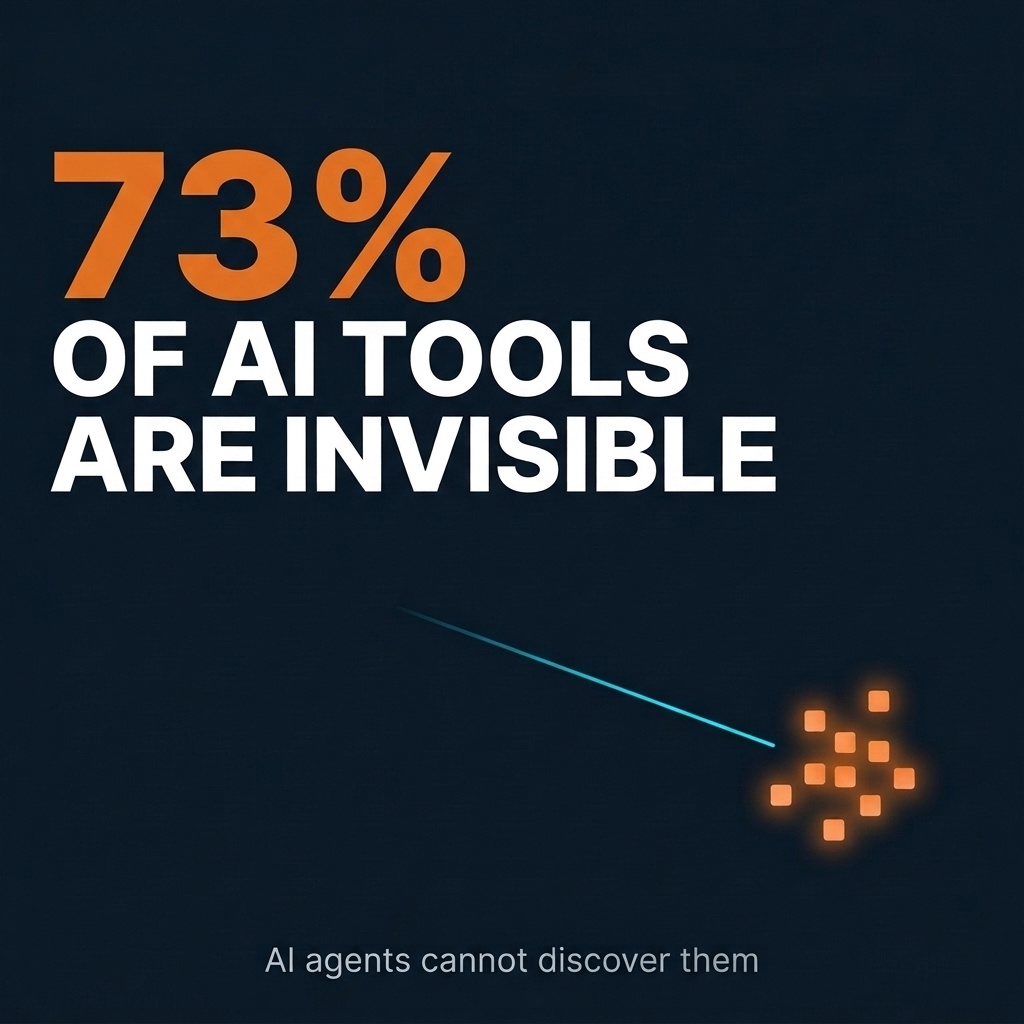
An audit of MCP servers found that 73% have no readable tool definitions.
This means AI agents cannot see them. Cannot use them. Cannot access the functionality you paid for.
Companies are buying tools their AI cannot touch and calling it an AI strategy.
The governance gap is not policy. It is discoverability.
The Bottleneck Is Never Where You Think It Is
Most enterprises are writing AI policies faster than they are implementing the technical controls those policies describe. 63% of organizations cannot enforce purpose limitations on AI agents. 60% cannot terminate a misbehaving agent. 55% cannot isolate AI systems from the broader network.
But the real problem is hiding one layer deeper.
The bottleneck is not governance theater. It is not compliance documentation. It is not executive buy-in.
The bottleneck is that your AI agents cannot find the tools they are supposed to govern.
This is the 80/20 of the 80/20 of the 80/20. The core mechanic that actually moves outcomes. The invisible friction costing businesses time, capital, and momentum.
You can write perfect policies for tools your agents will never discover.
What the 73% Statistic Actually Means
MCP servers are becoming the default wiring between AI agents and enterprise applications. The protocol works. The infrastructure exists. By February 2026, MCP crossed 97 million monthly SDK downloads with adoption across every major AI provider.
But 73% of those servers have no readable tool definitions.
This is not a protocol failure. This is a configuration failure. A documentation failure. An failure.
The tools exist. The agents exist. The connection layer exists. But the agents cannot see what is available because no one made the tools discoverable.
Finding and setting up MCP servers is currently a manual process. Developers locate endpoints. Configure authentication. Ensure compatibility. AI agents cannot dynamically discover or adapt to available servers.
At enterprise scale, the challenge is no longer how to call a tool. It is how an agent discovers which tools exist and which ones it is allowed to use.
If discovery is incomplete, insecure, or outdated, agents will make poor decisions even if underlying tools work perfectly.
The GenAI Divide: Pilots That Never Scale
A staggering 95% of generative AI pilots in companies fail to scale. 74% of companies struggle to achieve and scale AI value.
The 95% failure rate represents the clearest manifestation of the GenAI Divide. The core issue is the learning gap for both tools and organizations. Not model quality. Not compute resources. Not talent.
Tool procurement does not equal AI strategy.
Organizations are deploying AI without the foundational technical readiness required for successful implementation. They can launch pilots. Far fewer can integrate AI into the day-to-day work that drives real business outcomes.
According to MIT Sloan Management Review research, companies that invested in comprehensive data infrastructure before launching AI initiatives were 2.6 times more likely to achieve expected business outcomes.
The infrastructure layer beneath AI strategy is constantly shifting. 57% of organizations add new data systems every week. Manual mapping does not scale.
The AI Proof Gap: Can You Show It Works?
Organizations deploying AI cannot show how decisions are made and who is accountable. This creates the AI proof gap.
AI adoption does not fail because the technology is not capable. It fails because the organization is not ready.
Deloitte research finds 74% of organizations plan to adopt agentic AI within the next two years. However, only 21% currently have a mature governance model for AI agents.
This is the most urgent governance challenge enterprises face in 2026.
35% of organizations admit they could not shut down a rogue AI agent if one emerged.
Deploying autonomous systems without shutdown capability is an operational liability.
The Shadow AI Problem: What You Cannot See
MCP servers are becoming the default wiring between AI agents and enterprise applications. But most organizations have zero visibility into where they are, what they expose, or how they can be abused.
Only 25% of organizations have comprehensive visibility into how employees use AI. 35% describe shadow AI as pervasive.
In the past 12 months, 40% of organizations reported inaccurate AI outputs. 22% faced legal claims tied to AI use.
The top barriers to AI adoption in enterprise are lack of employee AI skills (35%), difficulty integrating AI with existing systems (29%), and data quality issues (29%).
Each unintegrated application represents lost insights, duplicated effort, and increased security risk.
How to Audit Your Stack Before Your Agent Does It for You
The governance gap is not about policy formulation. It is about the foundational technical accessibility and discoverability of tools by AI systems.
Here is how to audit your enterprise AI readiness.
1. Map Your MCP Server Inventory
Identify every MCP server currently deployed in your environment. Document which applications they connect to. Record who owns them. Track when they were last updated.
If you cannot produce this list in 48 hours, you have a discovery problem.
2. Verify Tool Definition Readability
For each MCP server, confirm that tool definitions are machine-readable and properly formatted. Test whether an AI agent can parse the available functions without human intervention.
The 73% statistic exists because this step is skipped.
3. Audit Access Controls and Permissions
Document which AI agents have access to which tools. Verify that permission boundaries are technically enforced, not just documented in policy.
Can you terminate an agent’s access to a specific tool in under 60 seconds? If not, you cannot enforce purpose limitations.
4. Test Agent Shutdown Procedures
Run a drill. Simulate a rogue agent scenario. Measure how long it takes to isolate and terminate the agent.
If you are in the 35% that cannot shut down a misbehaving agent, this is your highest priority fix.
5. Establish Discovery Automation
Manual discovery does not scale. Implement automated discovery mechanisms that allow agents to identify available tools dynamically.
This requires standardized metadata, centralized registries, and real-time synchronization across your tool ecosystem.
6. Implement Continuous Monitoring
Track which tools agents are attempting to access. Monitor for unauthorized discovery attempts. Log all agent-tool interactions for audit trails.
You cannot govern what you cannot see.
7. Build Integration Before Procurement
Before buying another AI tool, verify it can integrate with your existing infrastructure. Confirm it supports standard discovery protocols. Test that your agents can actually use it.
Tool procurement without integration readiness is waste.
The Real Work Starts Now
The bottleneck is never where you think it is.
Most companies are optimizing for the wrong things. Strategy does not matter if the execution is broken. Talent does not matter if the system is chaotic.
You need focus. Not just any focus. Laser focus on the unglamorous infrastructure layer most executives overlook.
The governance gap is hiding in plain sight. In the 73% of tools your AI cannot see. In the 95% of pilots that never scale. In the 78% of executives who cannot prove their AI works.
Audit your stack. Fix discoverability. Build the infrastructure that makes governance possible.
Do it now before your agent does it for you.