
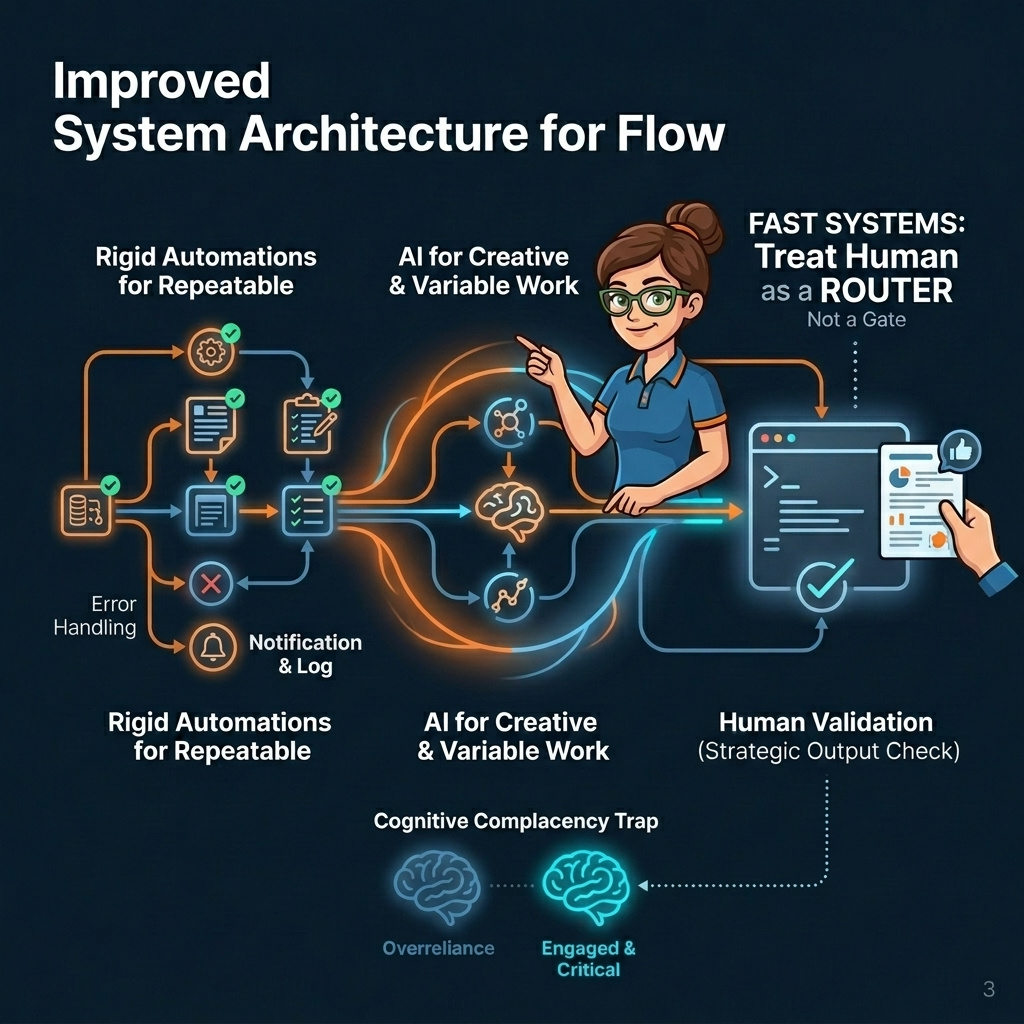
TL;DR: Real-time AI supervision produces mental fatigue that exceeds the fatigue of doing the work manually. More oversight is not the fix. Better architecture is. That means rigid automation for repeatable tasks, AI for creative work, and humans validating outputs, not watching processes.
-
Real-time monitoring creates a perverse incentive: supervisors need the system to fail to justify their role.
-
Harvard research shows the oversight burden of AI often exceeds the cognitive savings it delivers.
-
The MABA-MABA trap (Men Are Better At, Machines Are Better At) produces new failure modes when humans patch algorithmic flaws.
-
Humans belong at the output stage, not inside the execution loop.
-
The fix is architectural, not supervisory.
SOC teams process an average of 4,484 alerts daily. 67% get ignored.
That’s not a discipline problem. That’s a system design failure.
When you put a person in front of a screen to watch AI agents work, you produce a specific form of cognitive exhaustion. The fatigue doesn’t come from doing the work. It comes from watching machines fail and catching errors before they compound.
What Is the Real Cost of Real-Time AI Monitoring?
The person monitoring AI failures in real time isn’t functioning as a supervisor. They’re functioning as a hostage.
They’re not doing their own work. They’re not analyzing error patterns after the fact. They’re watching live execution, which creates a perverse incentive: they need the system to break so they have justification for their role.
This position is psychologically destructive. More importantly, it’s entirely preventable.
Harvard research identifies a systematic side effect organizations routinely underestimate during AI adoption: the oversight burden AI introduces often exceeds the cognitive savings it delivers.
Bottom line: Real-time monitoring converts efficiency gains into cognitive debt.
Why Does Automation Create More Work Instead of Less?
Automation simultaneously increases and decreases mental workload. The contradiction is structural, not accidental.
As automated systems become more sophisticated and reliable, human oversight becomes more critical for system function. Psychologist Lisanne Bainbridge documented this paradox in 1983. Organizations are still building systems that ignore her findings.
Continuous monitoring of reliable systems degrades attention and reduces sensitivity to anomalies. When humans supervise highly reliable autonomous systems for extended periods, attention drifts and abnormal signal detection deteriorates.
This produces supervisory failure at scale.
What Is Micro-Decision Overload and How Does It Kill Productivity?
An engineer using an AI assistant evaluates dozens of generated code lines every few seconds. Each evaluation requires a micro-decision. Execute hundreds of those daily without breaks, and executive function collapses.
Professionals who heavily oversee AI outputs report persistent mental fog and focus degradation. Time saved by AI gets consumed by fragmented task proliferation. That’s workload creep.
The cognitive burden of AI oversight is high because AI tools are designed as assistants. They produce partial outputs and demand human review at every step.
For most workflows, that design philosophy is wrong.
Core insight: Constant micro-validation destroys the efficiency AI is supposed to create.
How Does the MABA-MABA Framework Trap Organizations?
Policymakers assume humans excel at certain tasks and machines excel at others. This creates the MABA-MABA trap (Men Are Better At, Machines Are Better At).
When organizations insert humans to patch algorithmic flaws, they create new failure modes. The machine transfers control at the worst possible moment, or the human becomes a rubber stamp for decisions already made by code.
Tesla autopilot has returned control to drivers less than one second before collision.
Velocity doesn’t collapse because humans are in the loop. It collapses because the loop is designed without consideration for flow, incentives, or cognitive load.
What Does Flow Design Failure Look Like in Practice?
When the same error class appears repeatedly in review but upstream processes remain unchanged, the human is compensating for a design flaw.
Over time, they either burn out or stop checking. Neither outcome is acceptable.
High-velocity systems with human involvement don’t treat humans as gates. They treat humans as routers.
Automation should be rigid and structural. Same input produces same output. Think of it like a character build in an RPG. You define the rules upfront, and the system executes them without improvisation.
Creative work using multi-agent systems requires human involvement at some point in each process. But not a person watching execution in real time.
The distinction matters: Validation is productive. Observation is waste.
What Architecture Actually Solves the Supervision Problem?
The fix isn’t additional supervision. The fix is architectural redesign.
Rigid Automations for Repeatable Work
If a process follows a template, run it without human intervention. Build error handling into the system. When something breaks, the system stops and sends a notification. Humans review logs after execution, not during.
AI for Creative Work
AI handles variable work requiring judgment, adaptation, and synthesis. It doesn’t request micro-decisions at every step. It completes full cycles and presents output for validation.
Humans at the Output Stage
People expecting output validate end results. They don’t watch processes unfold in real time. This creates checks and balances without hostage dynamics.
This isn’t theoretical. This is how systems that scale are built.
How Does AI Create Cognitive Complacency?
A 2025 study by Microsoft and Carnegie Mellon researchers found knowledge workers who relied heavily on AI assistants engaged in less critical thinking about tool outputs.
Increased trust in AI accuracy correlates with decreased engagement of analytical faculties. The human role shifts from problem-solving to answer-verification.
That shift is subtle, but structurally significant.
Cognitive complacency emerges when AI overreliance erodes the critical-thinking capacity organizations need most.
What Does Systems Thinking Mean for AI Implementation?
Systems thinking isn’t about layering additional oversight. It’s about designing for appropriate human involvement at appropriate times.
Organizations treating AI as a supervised tool rather than architected infrastructure miss massive opportunities. People who think in systems rather than single-channel tactics have structural advantages.
The difference is fundamental.
Tools require constant attention. Infrastructure runs autonomously and alerts you when intervention is needed.
When systems produce results on autopilot, human capital and time return to the organization. The only requirement is creative input. Automation handles execution.
Key principle: Design systems to run without heroic individual effort.
How Should You Measure AI Implementation Success?
Success isn’t measured by alert processing volume. It’s measured by whether the business operates without requiring heroic effort from any single person.
That means building redundancy, installing failsafes, and creating space for humans to function as humans.
Automation exists to restore humanity, not replace it. The goal isn’t efficiency as an end. The goal is returning time and capacity to people while business performance continues.
Structural truth: Sustainable systems free people instead of trapping them.
FAQ: AI Supervision Architecture
When should humans monitor AI in real time?
Real-time monitoring works for high-stakes, unpredictable environments where immediate intervention prevents catastrophic failure. For most business processes, post-execution validation is more effective and less cognitively taxing.
How do you know if your team has supervisory fatigue?
Signs include declining error detection rates, increasing rubber-stamp approvals, reports of mental fog, and team members expressing frustration about watching rather than doing work.
What is the difference between a gate and a router in system design?
A gate is a checkpoint where humans approve or reject at every step, creating bottlenecks. A router is a decision point where humans direct work to appropriate channels based on output validation, maintaining flow.
Does rigid automation mean no flexibility?
No. Rigid automation means predictable inputs produce predictable outputs without human intervention. Flexibility exists in how you route different work types to appropriate systems: rigid automation, AI, or human judgment.
How do you prevent cognitive complacency with AI tools?
Design validation checkpoints that require analytical engagement, not binary approval. Rotate responsibilities so individuals don’t exclusively verify AI outputs. Train teams to interrogate conclusions rather than accept them.
What types of work should never be fully automated?
Work requiring ethical judgment, strategic decision-making under novel conditions, stakeholder relationship management, and creative problem-solving in ambiguous situations should retain meaningful human involvement.
How long does it take to redesign supervision architecture?
It depends on system complexity and organizational constraints. Small workflow redesigns take weeks. Enterprise-wide architectural shifts take months. The investment repays through reduced cognitive load and increased output quality.
Can small teams implement this architecture?
Small teams benefit more because cognitive load per person is higher. The principles scale down: identify repeatable vs. creative work, automate the repeatable, validate the creative, and eliminate real-time watching.
Key Takeaways
-
Real-time AI supervision produces supervisory fatigue worse than manual work execution because watching machines fail is cognitively exhausting.
-
The oversight burden AI introduces often exceeds the cognitive savings it delivers, creating net negative productivity.
-
Effective architecture uses rigid automation for repeatable tasks, AI for creative work, and humans for output validation, not process observation.
-
Micro-decision overload from constant AI output evaluation degrades executive function and produces mental fog.
-
Cognitive complacency emerges when AI overreliance reduces critical thinking, shifting humans from problem-solvers to answer-verifiers.
-
Success is measured by whether businesses operate without heroic individual effort, not by alert processing volume.
-
Humans should function as routers directing work flow, not gates approving every step.
If someone on your team is watching AI agents execute work in real time, you have a design problem.
They’re not doing their own work. They’re not analyzing error patterns. They’re watching live execution, which creates perverse incentives.
That’s not supervision. That’s hostage-taking.
The fix is architectural. Rigid automation for repeatable tasks. AI for creative processes. Humans at the output stage for validation and strategic oversight.
Stop treating humans as gates. Start treating them as routers.
Build systems that run without you. Use recovered capacity to solve the next constraint.